
Still Thinking About Work? How to Reclaim Your Evening
You have left work, but the argument is still running in your head. You replay what your supervisor said while making dinner, then rehearse tomorrow's reply while someone at home is talking to you. The shift ended. Your attention did not come home with you.
You do not need a perfectly work-free mind to recover. Research suggests that deliberately changing your focus can help your mood, and that a genuine positive reflection about work can sometimes help too. The useful question is: “Is this thought helping me move forward, or keeping the difficult part of the day going?”
Is all thinking about work bad for recovery?
No. In two laboratory experiments, researchers asked people to think about a hobby, detach from work, or think about work in positive, negative or unspecified ways. Both detachment approaches reduced negative feelings; positive work reflection also showed benefits and outperformed detachment in some comparisons. These were short-term mood effects, not evidence that positive thinking treats burnout. Read Sonnentag and Niessen's experiments.
That distinction matters if you enjoy telling your partner about a job well done. You do not have to treat that conversation as a recovery failure. A satisfying memory and an escalating replay of an insult are different experiences, even though both involve work.
Can switching off actually be learned?
A 2021 meta-analysis combined 30 studies involving 3,725 participants and found a modest average improvement in detachment from work following interventions. Programmes differed, and longer interventions tended to work better than shorter ones. The review included approaches aimed at job stressors as well as how people interpreted and responded to them. Read Karabinski and colleagues' review.
The two findings fit together: recovery skills can improve, but you need not judge success by whether work disappears from your mind. Try changing how you spend the transition into your evening, then notice whether you become more available for the life in front of you. A brief exercise is a starting experiment, not the equivalent of a full programme.
Try this after one ordinary workday
The following is an illustrative way to apply the research, not a clinically tested four-step treatment.
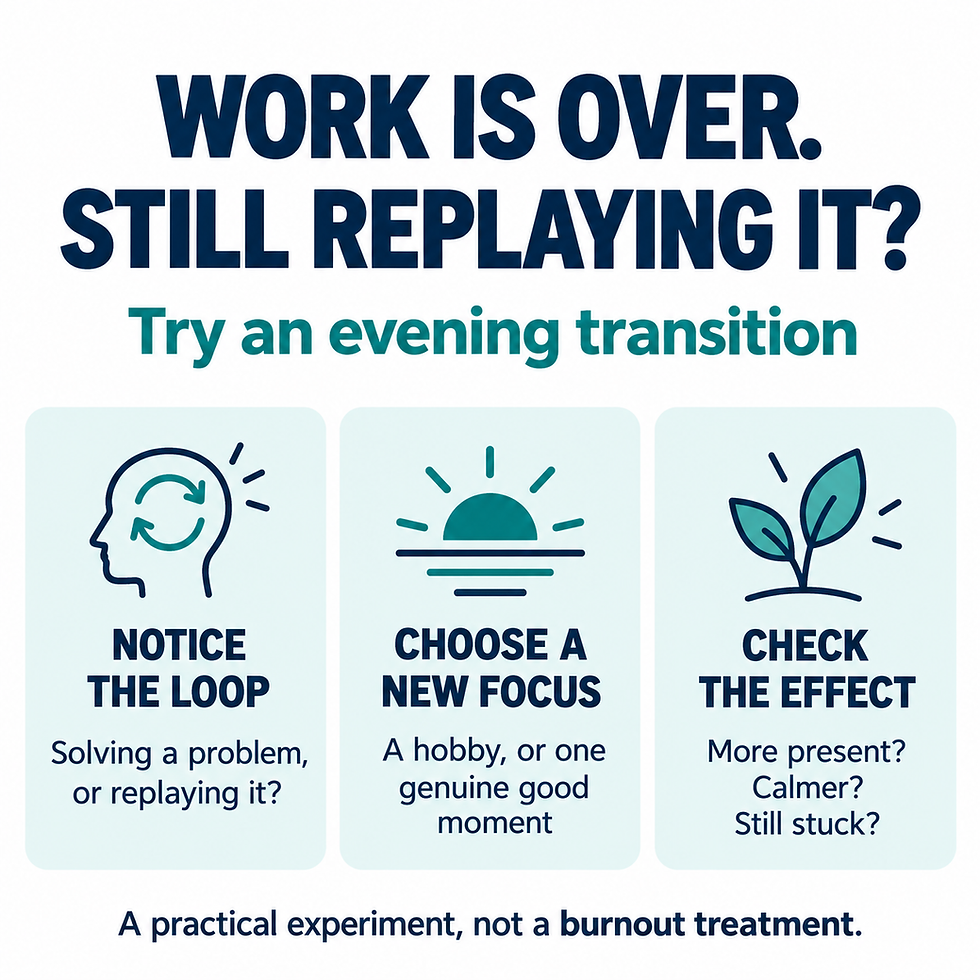
Name what you are doing. Ask, “Am I deciding something, remembering something good, or replaying the same upsetting moment?” For example, identifying who needs a question tomorrow is different from rehearsing the same imaginary argument for the fifth time.
Choose a focus you can actually engage with. If you are stuck in a replay, turn toward a non-work interest: consider what you want to cook, play a piece of music, or get involved in a hobby. Choose something that interests you rather than another task you think you ought to perform.
Allow a genuine positive reflection if it fits. You might recall a colleague helping you or something you handled well. You do not have to invent a silver lining, excuse mistreatment, or force gratitude. A non-work focus remains an option.
Check the effect on your evening. After the transition, ask whether you are more present for a conversation or activity. If the exercise turns into more work analysis, try the non-work option next time. You are gathering information, not awarding yourself a pass or fail.
What could this look like at home?
Here is a hypothetical example. A man notices he is mentally defending himself against a comment made hours earlier. Nothing new is being decided. He tells his partner, “I'm still caught in that conversation. I want to be here with you,” then joins in making dinner and focuses on the meal.
On another day, he happily talks about helping a new coworker learn something. That is not automatically a habit he needs to eliminate. The aim is room for recovery and connection, rather than a rule that he must never mention his job.
When the problem needs more than an evening routine
If work requires you to stay reachable, clarify the actual expectations before changing your availability. If the pressure comes from unreasonable demands or mistreatment, a personal routine cannot resolve that on its own. Discuss the situation with an appropriate trusted workplace contact where feasible.
If distress persists or affects sleep, relationships or everyday functioning, seek professional support. Alberta Men's Counselling provides online counselling for men across Alberta, including workplace pressure and stress. You can ask about fit and bring a specific example: “Even when I'm home, I keep replaying work and miss what's happening around me.”
The takeaway: coming home mentally does not require erasing your workday. Notice an unhelpful replay, choose a different focus, and judge the experiment by whether it helps you reconnect with your evening.
Educational information. Research and service links checked October 19, 2026.


Comments