
Putting Things Off? What Helps With Procrastination
The email takes ten minutes. You have spent three days thinking about it. Each time you open it, you find something else that suddenly feels more urgent.
When putting things off becomes a pattern, try a specific task experiment rather than another promise to become more disciplined. Research suggests that structured psychological help can reduce procrastination. It does not establish a magic productivity trick. The useful shift is to identify what happens at the point of avoidance, make the next action concrete, and review whether the plan actually helped.
Can procrastination respond to treatment?
Did you know researchers have tested treatment specifically for procrastination? A 2015 randomized trial involving 150 participants compared guided online cognitive behavioural therapy, an unguided version and a waiting list. Both treatment groups improved more than the waiting-list group on self-reported procrastination. The study did not find either treatment format superior to the other.
That matters if your conclusion has been, "This is just who I am." The pattern may be workable. But an online CBT programme is more than a motivational article, and improvement was not universal. The study reported clinically significant change in a minority of participants, with the proportion varying by measure and treatment group. A promising average result does not mean everyone needs the same approach.
One encouraging study is not the whole picture
A 2018 systematic review of 12 studies involving 718 participants found a small average benefit from psychological treatments compared with inactive controls. Results varied considerably. A smaller analysis of three CBT studies found a moderate benefit, but that limited evidence cannot establish CBT as the best option for everyone.
These are not two independent bodies of evidence: the earlier trial was included in the review. They also relied on self-reported outcomes. Feeling less stuck matters, but it is not identical to proving that work performance or every missed deadline improves.
A reasonable conclusion: persistent procrastination deserves a targeted plan, not a character judgement. Structured help has evidence behind it; a home experiment is a way to learn about your own pattern, not a substitute for the programmes studied.
Turn one avoided task into an experiment
The Centre for Clinical Interventions workbook addresses unhelpful assumptions, discomfort and practical action. Its practical strategies sheet recommends clarifying tasks, breaking them into steps and testing approaches that suit the situation. Here is an illustrative way to use those ideas.
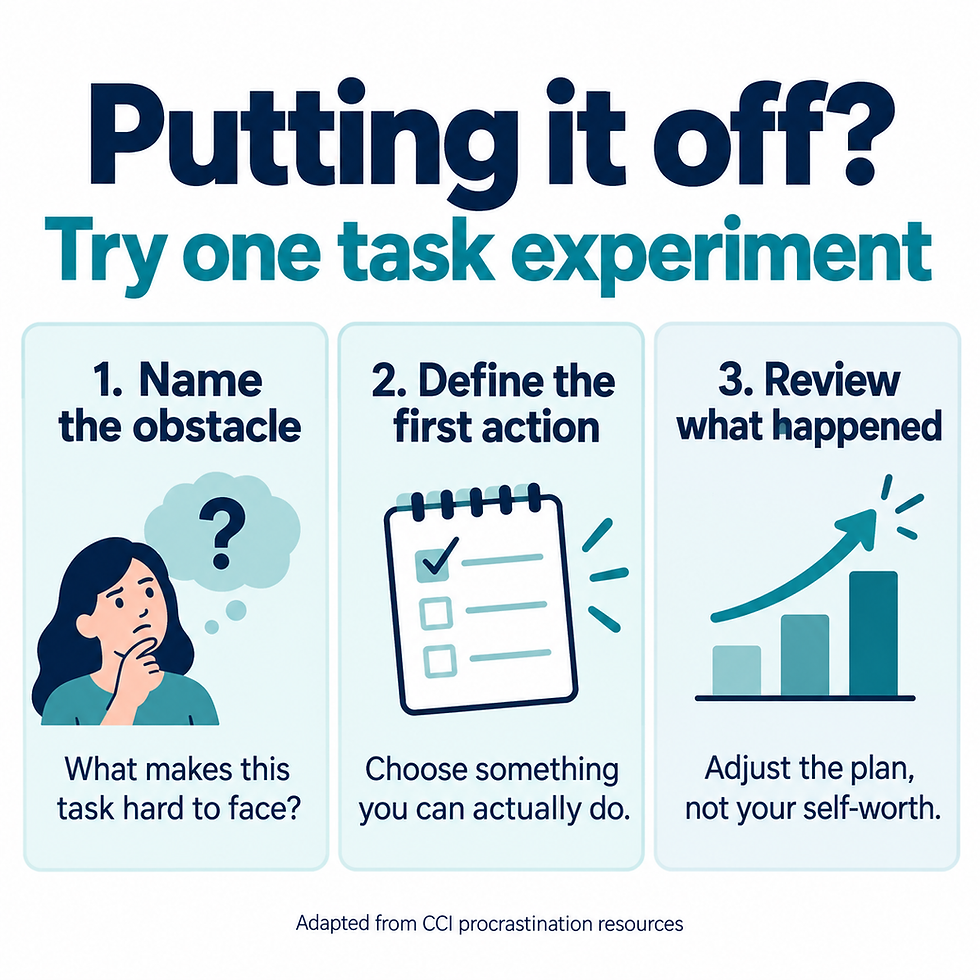
1. Name the obstacle without insulting yourself
Instead of "I am useless with email," try "I do not know how to explain the delay." That gives you something to work on. Perhaps you need information, a decision or help wording an uncomfortable message. A genuinely overloaded schedule also needs a different response from an avoided task.
2. Define an action you could observe
Replace "sort everything out" with "open the message and draft the first two sentences." Choose a realistic time and place. This is an example, not a scientifically established dose of effort. The point is to make the beginning clear enough that you can tell whether it happened.
3. Compare your prediction with the result
Before starting, note what you expect: "I will have nothing useful to say." Afterwards, record what actually happened. Maybe you wrote a rough opening but discovered a missing invoice number. Your next step is now finding that number. If you did not start, identify the obstacle and change the plan; repeating a judgement about yourself adds no new information.
When a task experiment is not enough
If repeated avoidance is costing you work, relationships or essential appointments, bring concrete examples to a qualified professional. Explain what you put off, what happens when you try, and what else has changed in your life. A blog cannot determine the reason for those difficulties.
Men across Alberta can ask about online counselling and whether support fits their concerns. Ask how progress would be reviewed and whether another assessment or service might be appropriate. This article does not claim that the clinic offers the specific online programme tested in the trial.
The takeaway
Pick one real task, name its obstacle and define the next visible action. Then use what happened to improve the plan. If the pattern keeps causing harm, ask for structured help rather than waiting for a different personality to arrive.
General education for adults, not individual assessment or treatment. Sources checked October 10, 2026.


Comments